PLACES TO SEE
|
CLICK BELOW TO VIEW |
Arend Dieperink Museum | Cheerio Gardens | Bakone Malapa Museum | Cyril Jackson Observatory | Hugh Exton Photographic Museum |
Land Of Modjaji - The Rain Queen | Largest Baobab in the world | Letaba Elephant Museum | Makapan Valley World Heritage Site |
Mapungubwe Museum | McNeil Clivia Collection | Modjadji Cycad Forest | Mogalakwena Craft Village | Nyani Tribal Village |
Polokwane Art Museum | Polokwane Museum | Rhino Park | Swadini Reptile Park | Tsonga Kraal Museum | Woodbush State Forest
|
| |
| Polokwane Museum |
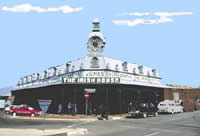 |
The Polokwane Museum was built in 1906 by Moschke, a German immigrant and in 1920 he sold the museum to JA Jones.
Mr Jones gave the museum the name of 'Irish House'.
The building is from the beautiful Late Victorian style and was restored to its original splendor in 1986 when it was declared as a museum. New exhibitions are planned for 2006-2007.
Works from well known artists and sculptors like Naria Mabasa, Danie de Jager, Jackson Hlungwane, Hennie Potgieter and John Baloyi, to name a few, are on exhibition |
|
CONTACT US : +27 (0)15 290 2177.
|
| |
| The Land Of Modjaji - The Rain Queen back to top |
 |
Enchanting myths, legends and culture found its home here in the place where this mysterious and magical woman's ancestors finally settled. Modjadji is a direct descendant of Monomotapa who was the ruler of the Karanga people in Zimbabwe in the 15th century. After a scandal in the royal house, his daughter (Princess Dzugugnini) and her son fled to the south. She took potions and other secrets for making rain with her. These unique powers were passed on through generations.
Her granddaughter were the first crowned Riaan Queen (Modjadji). Her story was told in a novel by Sir Rider Haggard and the novel was named 'She'. She was loved and feared far beyond the boundaries of her small kingdom and, according to legend, many great kings have left her nation untouched and often called on her unique powers. |
|
| |
| Bakone Malapa Museum back to top |
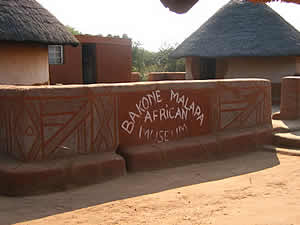 |
The name of the museum is derived as follows; Bakone - is the name of a local ethnic group / Malapa - means homestead.
The Museum concentrates on the traditional way of life of the Northern Sotho People.An archaeological site, dating from the 17th century consisting of complex stone walling forms a link with the museum.
Traditional cultural aspects have been revived and are demonstrated to visitors. Tradition includes hut building, thatching, metalwork, woodcarving, pottery, basketry and skinwork. A kiosk with souvenirs is available.
The museum is situated 9km outside Polokwane on the R37(to Burgersfort). The museum is open from 8:00 to 16:00 but closed on public holidays. |
|
CONTACT US : Tel: (015) 295 2432
|
| |
| Polokwane Art Museum back to top |
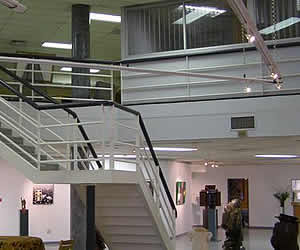 |
This modern museum is housed in the Library Gardens Complex.
The visitors are always entertained and their interest sparked by a dynamic interchange of exhibitions especially in the high season (August to December).
The museum boasts more than 1200 (and growing) pieces and is the most extensive municipal collection.
In August they display the works of artists in the Limpopo Province of South Africa.
The museum also boasts two outdoors components, namely the Industrial Art Park (on the N1 north to Makhado) and the Bronze and Steel sculptures all over Polokwane, with the main focus on the City Plaza.
|
|
CONTACT US : (015) 290 2177
|
| |
| Mogalakwena Craft Village back to top |
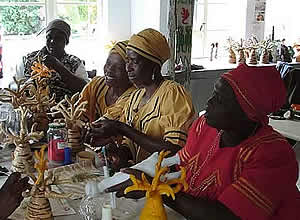 |
MOGALAKWENA CRAFT ART DEVELOPMENT FOUNDATION (MCADF)
was established in 1994 to create employment opportunities, promote the traditional arts and crafts and promote the restoration of craft art skills. MCADF specializes in the training of multiple skills - embroidery, bead work, candle making, sewing, basket weaving, cement work, basic computer literacy, practical first aid courses, AIDS awareness & care, children's art workshops and basic principles of cultural tourism.
The Village comprises the following:
The Artist's Retreat (a renovated farm house)- a refined bush retreat in Africa for creative minds, The Writer's Cottage (a renovated cottage), a Manager's House, staff accommodation, a thatched roof Garden Studio, a 40ft container donated by Safmarine, a vegetable garden, a creche and a basic health support centre and a Training Development Centre. |
The Foundation had humble beginnings in an old farm house where unemployed people from the neighbouring Lebowa Tribal Trust Land were trained in a variety of craft art skills and their products sold to enable them to earn an income. The Foundation started its work with two part-time craft artists and now employs 26 people on a full-time basis.
A huge escalation in orders resulted after publication of the book, Craft Art in South Africa published by Struik/New Holland Publishers and the Foundation was compelled to employ more people. In 1999/2000 the Foundation leased bigger premises and increased personnel, employees, and its marketing activities to UK, USA, France, Netherlands, Australia, Canada. In 2003 they were the Joint winner of the Nedbank/Mail & Guardian Cultural Project of the Year Award. |
|
CONTACT US
|
| |
| Modjadji Cycad Forest back to top |
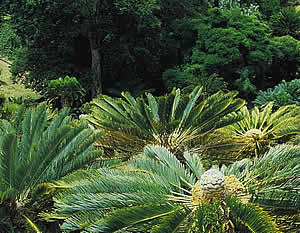 |
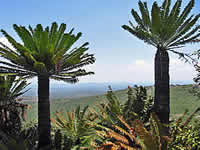
Cycad ( Encephalartos transvenosis).
A significant part of the Modjadji dynasty was formed by these cycads and the history of the Rain Queen is preserved in a small museum at the entrance to the reserve.
12 000 Mature cycads (the Encephalartos transvenosus species) has thrived to become one of the biggest cycad forest in the world.
Cycads are thought to have been around for maybe 50 – 60 million years, it is not certain how old these cycads are.
Seedlings can be seen everywhere in the shades of their giant (between 6m and 13m tall) ancestors. |
|
| |
| The largest Baobab in the world back to top |
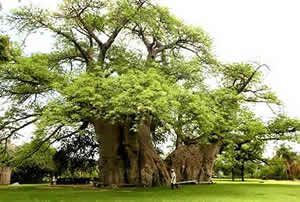 |
This Boabab forms a large and true land mark at Modjdjiskloof on a farm called Sunland, and has been referred to as the 'largest living thing in the world'. Carbon dating on the Sunland Baobab gives it an age of about 1060 years old.
The Sunland Baobab is about 22 meters tall and 47 meters in circumference. Inside the tree is a unique pub.
Day visitors can view all these qualities for themselves at only R10 p/person, while the pub can be booked for private functions.
Accommodation is also available as well as quad tracks (11km-enduro and 2km kiddies track) |
|
| |
| Makapan Valley World Heritage Site back to top |
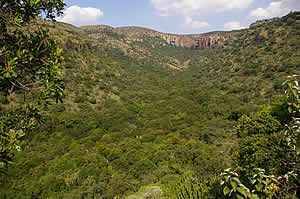 |
This world heritage site features the most complete record of hominid occupation. The Limeworks is the oldest site of +-3.32 million years old. Thousands of fossil bones including the remains of the gracile ape-man came from this site.
The Historic cave (ga-a-washa cave) depicts the clash between the Boere and the Langa and Kekana people. Chief Mugombane with his tribe and their cattle stayed in this cave for a month and many died of hunger and thirst. Piet Potgieter was shot during this feud. The Cave of Hearths & Hyena depicts a surprisingly complete record of human habitation from the Early, Middle and Later stone ages up to the iron age. Brass and Musket balls were some of the relics found when the excavations began.In the Buffalo Cave fossils of ancient, extinct buffalos were found. Other fossils include antelope, pigs, monkeys, horses and various carnivores. The Rainbow Cave is situated right beneath the Historic cave and shows signs of human occupancy as well as the controlled use of fire. |
|
CONTACT US : +27 (0)15 491 9740
|
| |
| Arend Dieperink Museum back to top |
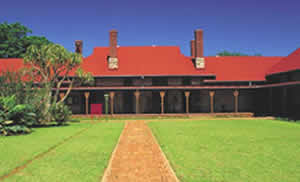 |
Located at 97 Thabo Mbeki drive, Mokopane, this graceful stone building was originally built as a school. In this museum the history of Vredenburg-then Pieter Potgietersrus- then Potgietersrus- now Mokopane and the surrounding areas from the earliest times including the Anglo-Boer war can be seen.
Other valuable artifacts include dinosaur fossil material and the replica of a traditional 'bosveldhuis' in which the white South African farmers lived.
Piet Potgieters grave can also be found here and tours can be arranged on request: |
|
CONTACT US : +27 (0)15 491 9735
|
| |
| Mapungubwe Museumback to top |
The University of Pretoria has been excavating this Iron age site since 1932. Artifacts made of gold, ivory and other materials include a little gold rhinoceros, a Golden Sceptre and the Golden Bowl and human remains. This site was added to the World Heritage List in June 2003 and described as the centre of the largest kingdom in the sub-continent before it was abandoned in the 14th century.
|
| |
| Tsonga Kraal Museum back to top |
Situated in the Hans Merensky Nature Reserve this museum represents the cultural products and building styles of the North Tsonga tribes. The tribes were comprised of refuge groups from the Southern parts of Mozambique.
The Museum attempts to show as many building styles as possible. The homestead of a Chief with eight wives was the basis around which the kraal was fashioned. The arrangement of the huts follows a set pattern but many variations of the pattern are found in the area. The kraal was built entirely from traditional materials. Mopane poles bound to mopane bark forms the framework of most huts, and clay from anthills were used for the floors and walls. Different coloured soils were used to make up the paint decorating the walls
|
| |
| Letaba Elephant Museum back to top |
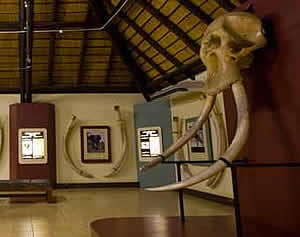 |
Located in the Kruger National Park at Letaba Camp (close to Phalaborwa Gate) this is an amazing museum, with a life size elephant statue at the entrance, a full-sized elephant skeleton, the tusks of six the famous eight and many spectacular ivory tusks inside.
Displays show how elephants evolved as a species, and include large murals and some elephant embrios.
The museum covers elephant evolution, biology, behaviour, ecology and research. It also showcases the ivory of eight of Kruger's greatest tuskers (including six of the Magnificent Seven). |
|
| |
| The Woodbush State Forest back to top |
 |
This is the largest indigenous forest in Limpopo and the 'Dap Naude Damand can be accessed via the scenic drive off the R71.
The dam offers a picnic spot in this oak forest just below the dam wall.
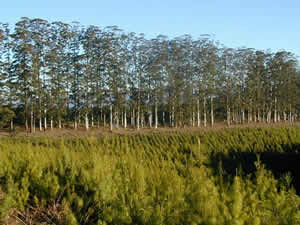
The O'Connor Memorial, also found in this forest, honours a former District Officer for the Woodbush Forest, Alexander O'Conner, and is found at the end of an avenue of enormous gum trees which was planted by Alexander himself! |
|
| |
| Cyril Jackson Observatoryback to top |
In 1955 Cyril Jackson constructed a small stone building at a hilltop close to Haenertsburg Village. He made several discoveries here which made him one of South Africa's leading Astronomers.His credits include 72 asteroids and 3 comets - everyone named after him. |
| |
| Cheerio Gardensback to top |
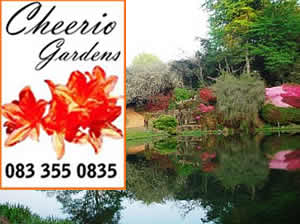 |
These gardens are situated in the Magoebaskloof area.
With hundreds of different Japanese flowering cherry trees that comes into bloom around late September to early October this is a world famous garden.
Banks of azaleas put up a wonderful display of warm pinks, purples and magenta.
Tea Garden is open from Wednesday to Sunday. |
|
CONTACT US
|
| |
| The McNeil Clivia Collectionback to top |
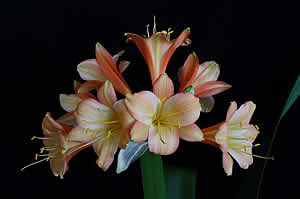 |
This is one of South Africa's best-known Clivia collections. This wild garden and a small stream is shaded by immense indigenous trees and are absolutely enchanting.
The collection started in 1962 when Gorden McNeil bought clivias from G.I.Blackbeard of Grahamstown in the Eastern Cape. He then planted these specimens in this shaded area in the Lekgalameetse Nature Reserve in the wild Drakensberg Escarpment. Here they flourished and variations were propagated using hand pollination, natural cross pollination and wind pollination. The plant concentration, the numbers of plants and the long period off establishment all makes for a great diversity.
The blooming takes place from the end of August to the beginning of October. |
|
CONTACT US : Cell 083 631 7153
|
| |
| Nyani Tribal Villageback to top |
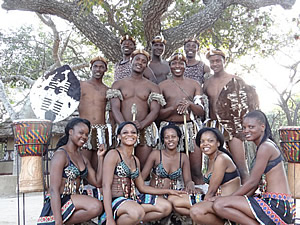 |
The history and culture of the African tribes comes to life at Nyani Cultural Village.
This new cultural attraction in Hoedspruit is an ideal destination for visitors and learners of all ages, with the program modified to suit all age groups in terms of content and duration.
The cultural journey starts in our boma theatre where guests experience our original show “Limpopo Pathways” featuring the costumes, songs and dances of the San (Bushmen), the Shona & Venda, the Tsonga, the Balobedu (Modjadji the Rain Queen), the Pedi and the BaHananawa (Tswana).
We also include the Swati and Zulu dances as these tribes played an influential part in the history of the Limpopo. |
|
CONTACT US
|
| |
| Swadini Reptile Parkback to top |
 |
To have an interesting view into the world of reptiles this is definitely the place to be!
Daily demonstrations are performed with exotic and indigenous snakes, crocodiles etc.
Have your picture taken with a giant boa and enjoy refreshments in the tea garden while watching the free ranging spider monkeys play. |
|
CONTACT US Tel: (015) 795 5203
|
| |
| The Hugh Exton Photographic Museum |
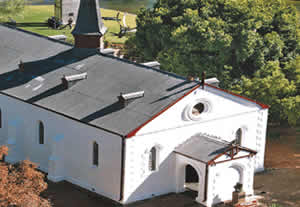 |
The museum is housed in a Dutch Reformed church built in Polokwane South Africa, in the 1890's.
The very valuable cultural, historical collection, consisting of more than 23 000 photos taken by Hugh Exton are mainly of Polokwane and its people and dates from the early 1890's to about 1945. The original (now somewhat delicate and fragile) photographs are preserved in this old church.
The exhibitions cover a variety of topics such as, the birth and development of Polokwane, architecture, industries, clothing, trade and famous town residents. |
|
CONTACT US Tel: (015) 290 2186.
|
| |
| Rhino Museum |
The Rhino Museum is located in Vaalwater, a small town in the Waterberg Massif, a large area of largely unspoilt wilderness, of around 15,000 square kilometers, in the north of Limpopo province. The Rhino Museum documents the habitats, evolution and landscapes, the illegal rhino horn trade and conservation to preserve rhinos. There are only four major populations of rhino surviving in Africa today : Kenya, Zimbabwe, Namibia and South Africa) and that South Africa has the highest population of both species.
|
| |